

What we fit
Home battery storage installation in CheshireBattery storage.
A home battery moves electricity through time. What the roof makes at one o’clock, when the house is empty, is there at seven when the oven, the kettle and the television are all on at once.
We do home battery storage installation across Cheshire. It also decouples you from the worst part of the day on a time-of-use tariff, and — with the right kit — keeps the lights and the fridge running when the street loses power.
In short
A home battery moves the roof’s midday surplus into the evening, and on a time-of-use tariff it can charge when grid electricity is cheapest; December and January make only about 7% of a south-facing roof’s year here, so in winter the tariff does the work. Batteries are zero-rated for VAT until 31 March 2027 when one firm supplies and fits them, and every one is notified to the network operator under G98 or G99.
The roof studio
Turn the house, fill the roof.
A Cheshire semi on a turntable. Drag it round, then tell it about your roof and your house — the panels, the battery, the current running through it and the numbers all move together.
01Your roof
02Your house
Estimated generation
3,870
kWh a year
Estimated saving
£834
a year, saved and earned
Estimated payback
10.1
years
System size
4.40 kWp
Panels
10
Your use covered
58%
Of what the roof generates
Worked out for a typical Cheshire roof at the pitch and aspect you picked, on a unit rate of 28p and an export rate of 6.5p — rates this tool assumes, dated September 2026, rather than any tariff you have been offered. Nothing here is a quotation: your roof, your shading and how much electricity you use while the sun is up are what the survey settles.
Take the figures with you.
Copy what the studio worked out for your roof, or send it straight to us with a survey request. None of it is a quote: the survey replaces every figure above with your own.
Every assumption behind the numbers
- Unit rate
- 28p for every unit (kWh) you’d otherwise buy from the grid.
- Export rate
- 6.5p for every unit the house and battery can’t use and send back to the grid.
- Your yearly use
- Worked out from your monthly bill at the 28p unit rate, after a standing charge of about 36p a day — and never less than 1,100 kWh a year.
- What a panel makes
- Each panel is 440 W (0.44 kWp). A kWp makes 880 kWh a year facing south, 760 facing east–west and 620 facing north-ish. For this part of Cheshire the EU’s PVGIS model gives 951 for a south roof at a typical pitch — the studio stays below it.
- Pitch
- Shallow (28°) makes 95% of a typical 38° roof; steep (48°) makes 97%.
- Shading
- A bit of shade costs 10%; heavy shade costs 24%.
- How many panels
- Two rows, growing with your bill from three columns to eight — six panels up to sixteen.
- How much you use yourself
- The share of what the roof makes that the house uses: 30% if you’re usually out, 46% in and out, 62% usually home. A battery adds 24 points and a car charger 6, up to 86% — and never more than 62% of your whole year’s use.
- Saving
- The units you use yourself at 28p, plus the units you export at 6.5p.
- Payback
- The yearly saving set against what a system like the one you’ve built typically costs to install: a base figure, an amount for each panel, and more again for a battery or a charger. The answer is held between 4 and 25 years. The studio never shows that cost, because only a survey can price your roof — so treat the years as a rough guide, not a figure to hold us to.
Monthly and yearly sunshine for this area: PVGIS 5.2, EU Joint Research Centre. The unit rate, the export rate and the standing charge are the studio’s own assumptions, set in September 2026 — not a tariff we have quoted you. Your own rates are on your bill, and a survey works from those.
Battery storage
Where the saving actually comes from.
Without storage, a household uses somewhere between a third and two thirds of what its roof generates, depending on how much of the day somebody is in, and exports the rest. With storage sized sensibly, most of the generation ends up going through the house instead.
The second half of the case is the tariff. If your supplier charges less overnight, a battery can be told to fill up then and carry you through the expensive hours, which helps even in the months when the roof is barely working.
Battery storage
What we look at before recommending a size.
- Your eveningWhat the house actually draws after four o’clock is what the battery has to cover. A half-hourly export from your supplier tells us more than any rule of thumb.
- The roof’s surplusThere is no point buying capacity the array will never fill. Size follows generation, not the other way round.
- Where it can liveGarage, utility, plant room or an outside wall, within the manufacturer’s temperature range and with the clearances their manual demands.
- Backup or notWhole-house backup needs a gateway and a rewire at the board. Some households want it; many would rather put the money into capacity.
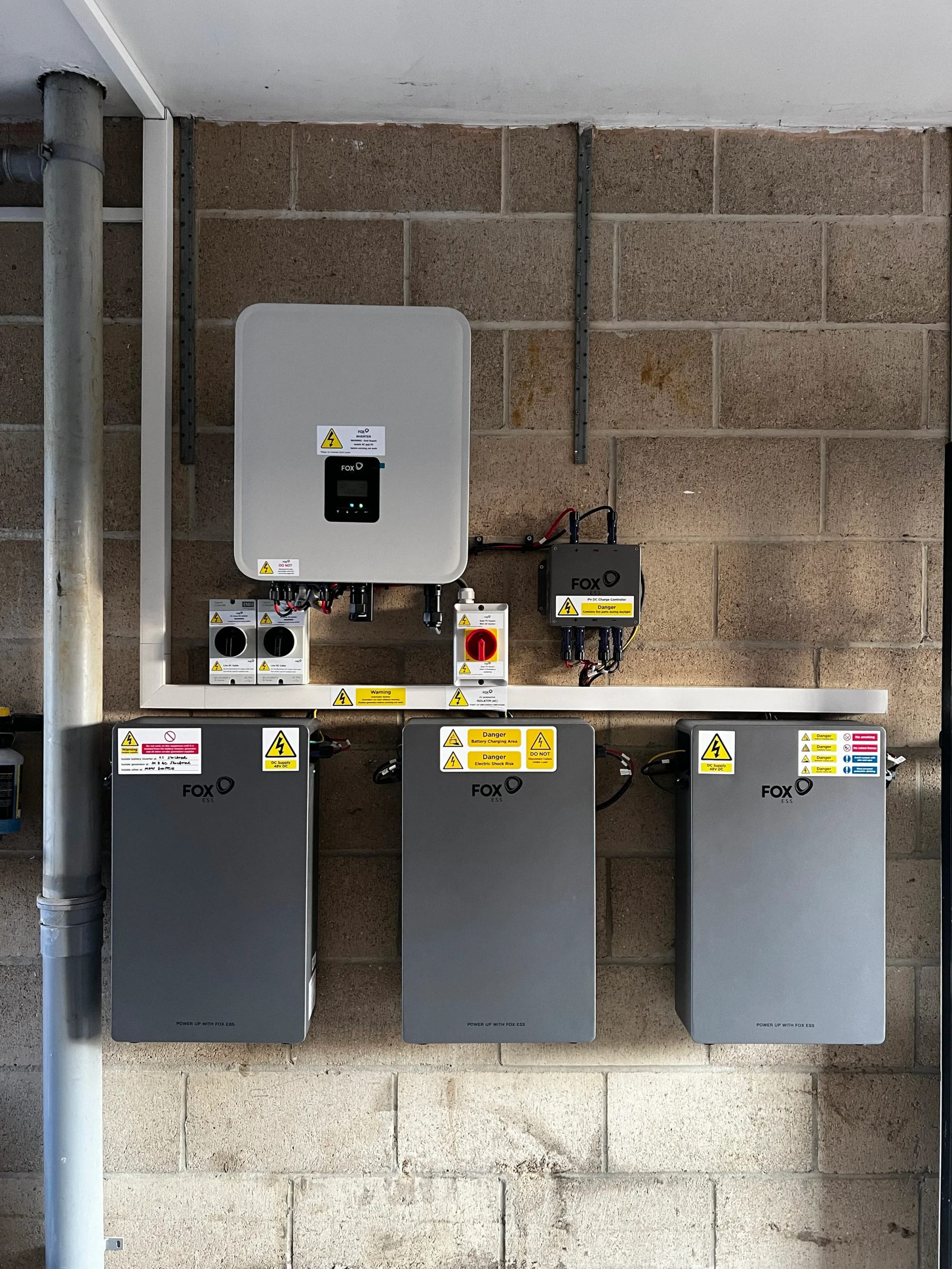
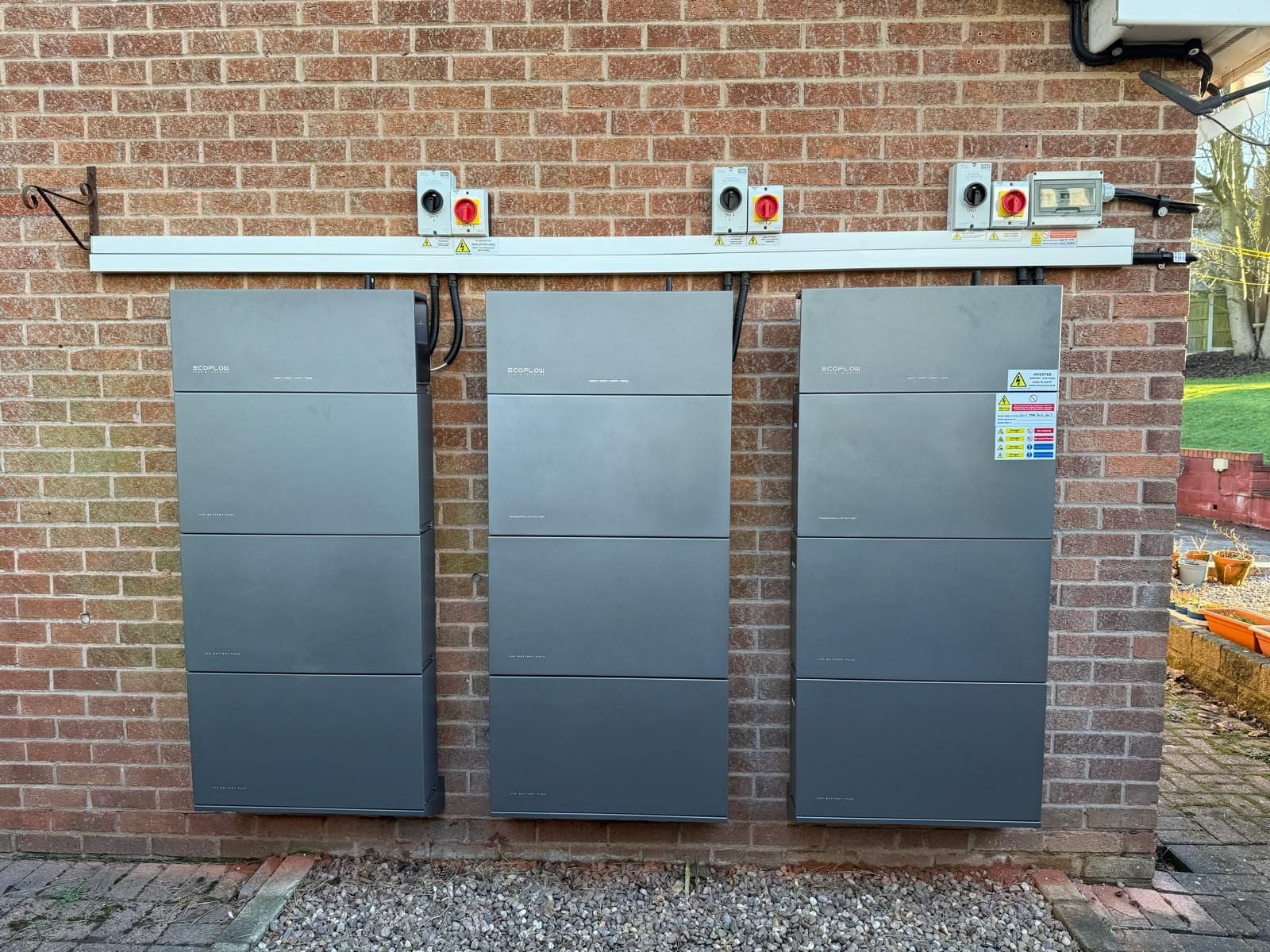
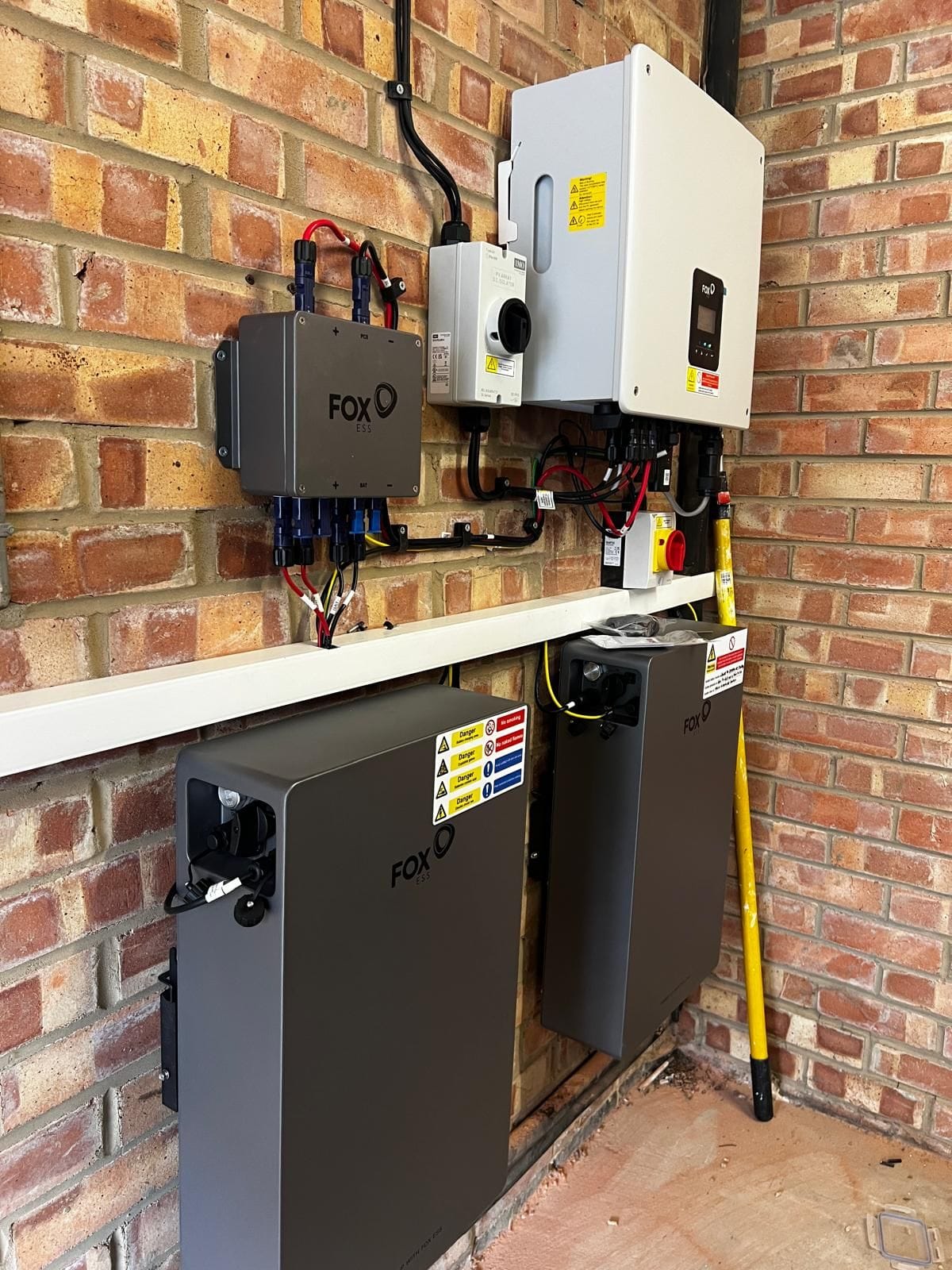
- The brandWe fit Tesla Powerwall, Fox ESS and EcoFlow. Which one suits depends on the space, whether you want backup, and what is already on the wall.
Battery storage
Fitted so somebody can work on it later.
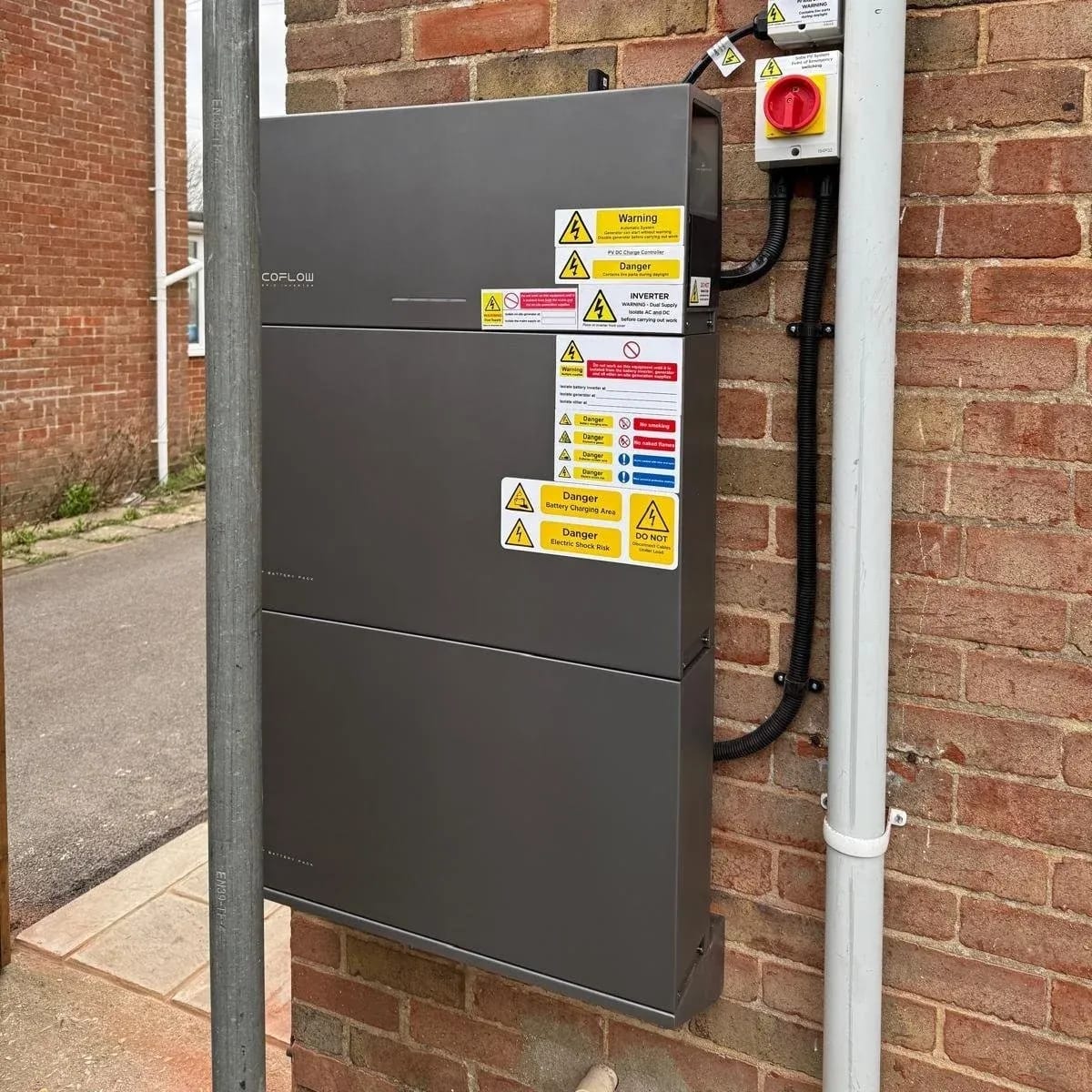
Batteries are heavy, they get warm, and they have to be isolated safely by whoever comes next. Ours go on a fixing that suits the wall, with labelled isolation, cable protected in trunking, and the clearances the manufacturer specifies rather than the clearances that happen to fit.
The MCS standard for battery storage sets out where a battery may and may not go in a home. We follow it, and the survey is where any awkwardness about siting gets settled.
Battery storage
Three things worth knowing before you choose.
- Usable, not total
- Manufacturers quote a total capacity and a usable capacity. The usable figure is the one your evening runs on.
- Power as well as capacity
- A battery has a maximum output. A big tank that can only pour slowly will not cover a shower, an oven and an immersion heater at once.
- Backup is a separate decision
- Keeping the house running through a cut needs a gateway between you and the street, and a choice about which circuits are worth carrying.
Battery storage
How a battery job runs.
- 01SurveyBoard, meter, siting and the route for the cable. If you already have solar, we check what the inverter will work with.
- 02DesignCapacity, output, where it goes, and whether a gateway is worth it — written down before anything is ordered.
- 03InstallUsually a day. Mount, wire, isolate, commission, and label everything we have touched.
- 04Set up with youCharging windows, the app and the tariff behaviour, with somebody standing next to you while it is done.
What we fit on these jobs
The kit, and the rest of the work.
Kit we fit for this
From the Google profile
Homeowners on this work.
11 of our 39 Google reviews mention battery storage. Here are 8 of them, word for word.
Asked on every survey
Battery storage, the questions first.
If yours isn’t here, give us a ring and ask, or see every question.
With solar battery storage, you’ll harness even more of your system’s potential, storing excess energy produced during the day for use during peak hours or at night, when electricity costs are higher. The battery keeps your home powered even after sunset, during peak hours, and in the event of outages.
Yes. Adding a retrofit battery to your existing solar system is a smart and cost-effective way to get more out of your investment. We install retrofit batteries to boost solar efficiency, cut energy bills, and provide backup power.
From the blog
Worth reading before you decide.
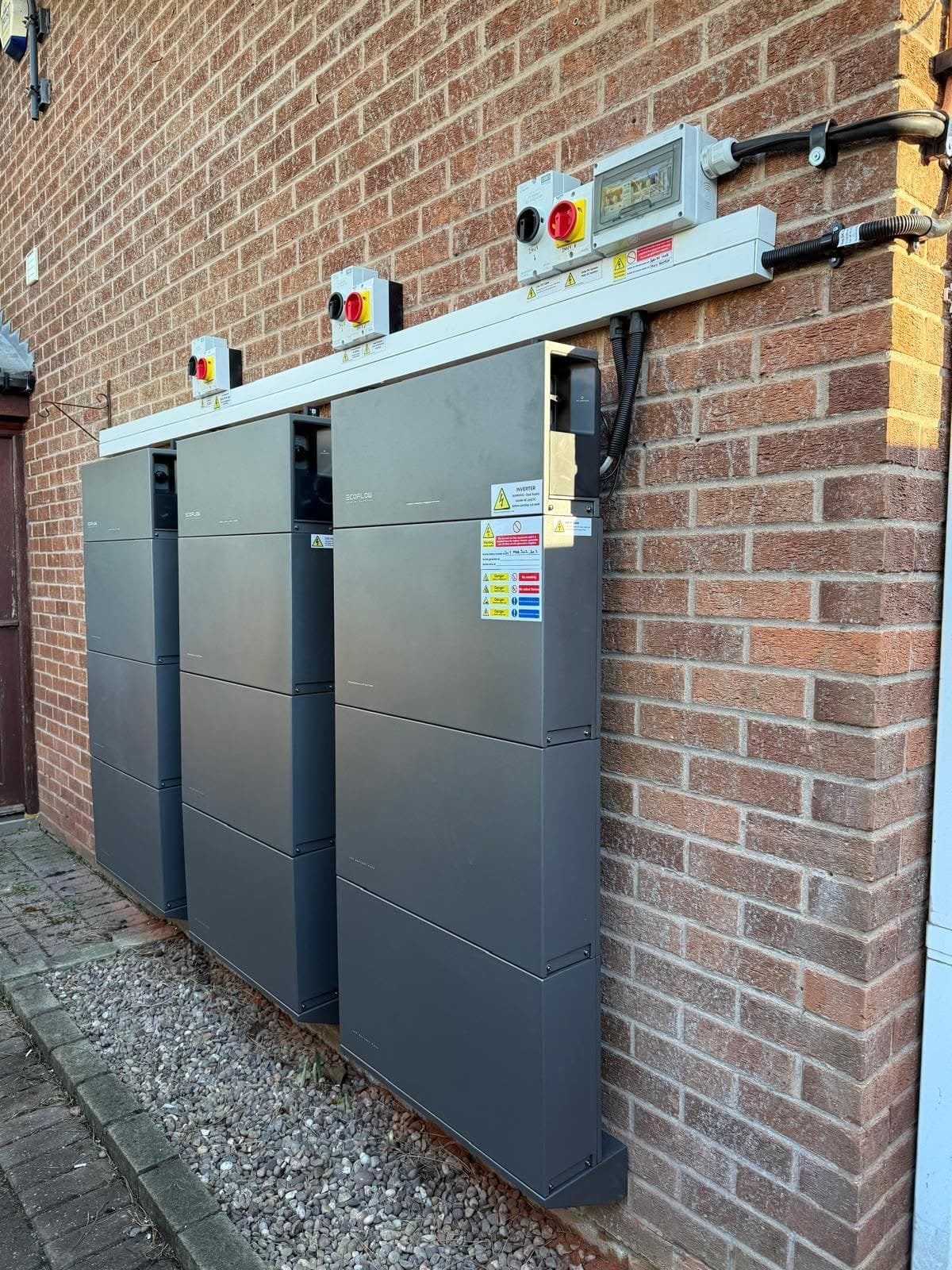
EcoFlow PowerOcean explained: packs, usable capacity and where it can go
EcoFlow PowerOcean from the installer's side: 5 kWh LFP packs, usable capacity, limits per inverter, backup output, cycle life, protection and mounting.
19 October 2026
Fox ESS batteries explained: EP batteries, K-series inverters and FoxCloud
A Fox ESS battery from the installer's side: EP capacities, the K-series hybrid inverter, new or retrofit, FoxCloud 2.0 work modes, protection, the cold.
19 October 2026
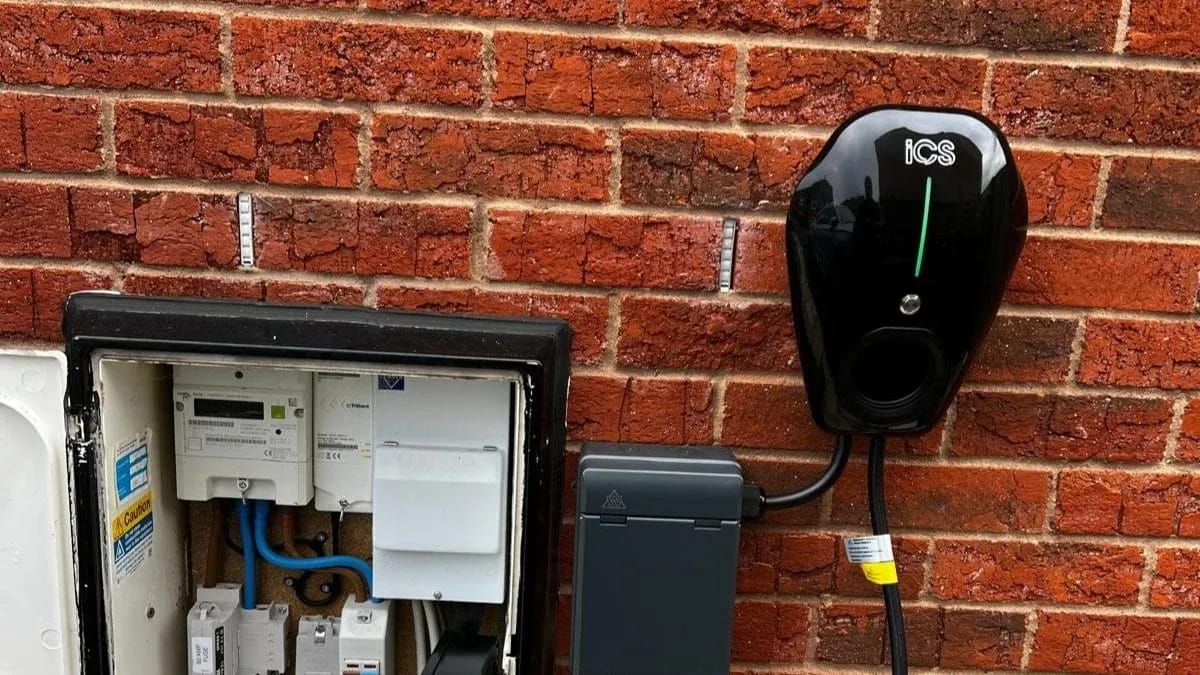
Intelligent Octopus Go: what it needs from your home charger
How Octopus Intelligent Go works with a home EV charger: the six-hour window, which chargers and cars it needs, and how it sits with solar and a battery.
19 October 2026
Where we do it
Home battery storage, town by town.
From our base in Ellesmere Port, across Cheshire, Merseyside and Greater Manchester. The towns nearest us come first.
- Chester home battery storageEllesmere Port · Helsby · Neston · Chester
- Home battery storage across Merseyside and the WirralBebington · Heswall · Birkenhead · Liverpool
- Home battery storage in StockportAltrincham · Manchester · Stockport
Cheshire
- Battery storage in Ellesmere Portunder 2 milesCheshire West and Chester
- Battery storage in Helsby6 milesCheshire West and Chester
- Battery storage in Neston6 milesCheshire West and Chester
- Battery storage in Chester7 milesCheshire West and Chester
- Battery storage in Frodsham8 milesCheshire West and Chester
- Battery storage in Runcorn8 milesHalton
- Battery storage in Widnes9 milesHalton
- Battery storage in Mold13 milesFlintshire
- Battery storage in Tarporley13 milesCheshire West and Chester
- Battery storage in Warrington15 milesWarrington
- Battery storage in Northwich17 milesCheshire West and Chester
- Battery storage in Winsford17 milesCheshire West and Chester
- Battery storage in Wrexham17 milesWrexham
- Battery storage in Middlewich20 milesCheshire East
- Battery storage in Nantwich22 milesCheshire East
- Battery storage in Knutsford22 milesCheshire East
- Battery storage in Crewe24 milesCheshire East
- Battery storage in Sandbach25 milesCheshire East
- Battery storage in Wilmslow28 milesCheshire East
- Battery storage in Congleton30 milesCheshire East
- Battery storage in Macclesfield32 milesCheshire East
The kit we fit in Cheshire: Tesla Powerwall installer, Cheshire · Fox ESS installer, Cheshire · EcoFlow installer, Cheshire.
Merseyside and the Wirral
- Battery storage in Bebington4 milesWirral
- Battery storage in Heswall8 milesWirral
- Battery storage in Birkenhead9 milesWirral
- Battery storage in Liverpool9 milesLiverpool
- Battery storage in Wallasey11 milesWirral
- Battery storage in West Kirby13 milesWirral
- Battery storage in Hoylake13 milesWirral
- Battery storage in St Helens14 milesSt Helens
- Battery storage in Southport25 milesSefton
The kit we fit in Merseyside & Wirral: Tesla Powerwall installer, Merseyside & Wirral · Fox ESS installer, Merseyside & Wirral · EcoFlow installer, Merseyside & Wirral.
Greater Manchester
- Battery storage in Altrincham24 milesTrafford
- Battery storage in Manchester30 milesManchester
- Battery storage in Stockport32 milesStockport
The kit we fit in Greater Manchester: Tesla Powerwall installer, Greater Manchester · Fox ESS installer, Greater Manchester · EcoFlow installer, Greater Manchester.
Before the survey: The Smart Export Guarantee explained · How to save energy at home with solar power · Tesla Powerwall 3, explained.
Battery storage installation across Cheshire, Merseyside and Greater Manchester, from our base in Ellesmere Port.
Start here
Start with a conversation, not a quote.
Tell us the postcode and roughly what you use. We’ll tell you honestly whether the roof is worth doing — and if it isn’t, that’s a perfectly good answer too.
- Takes about a minute
- You get a person, not a brochure
- No obligation, and no visit until you ask for one