
Fox ESS batteries explained: EP batteries, K-series inverters and FoxCloud.
A Fox ESS battery from the installer's side: EP capacities, the K-series hybrid inverter, new or retrofit, FoxCloud 2.0 work modes, protection, the cold.
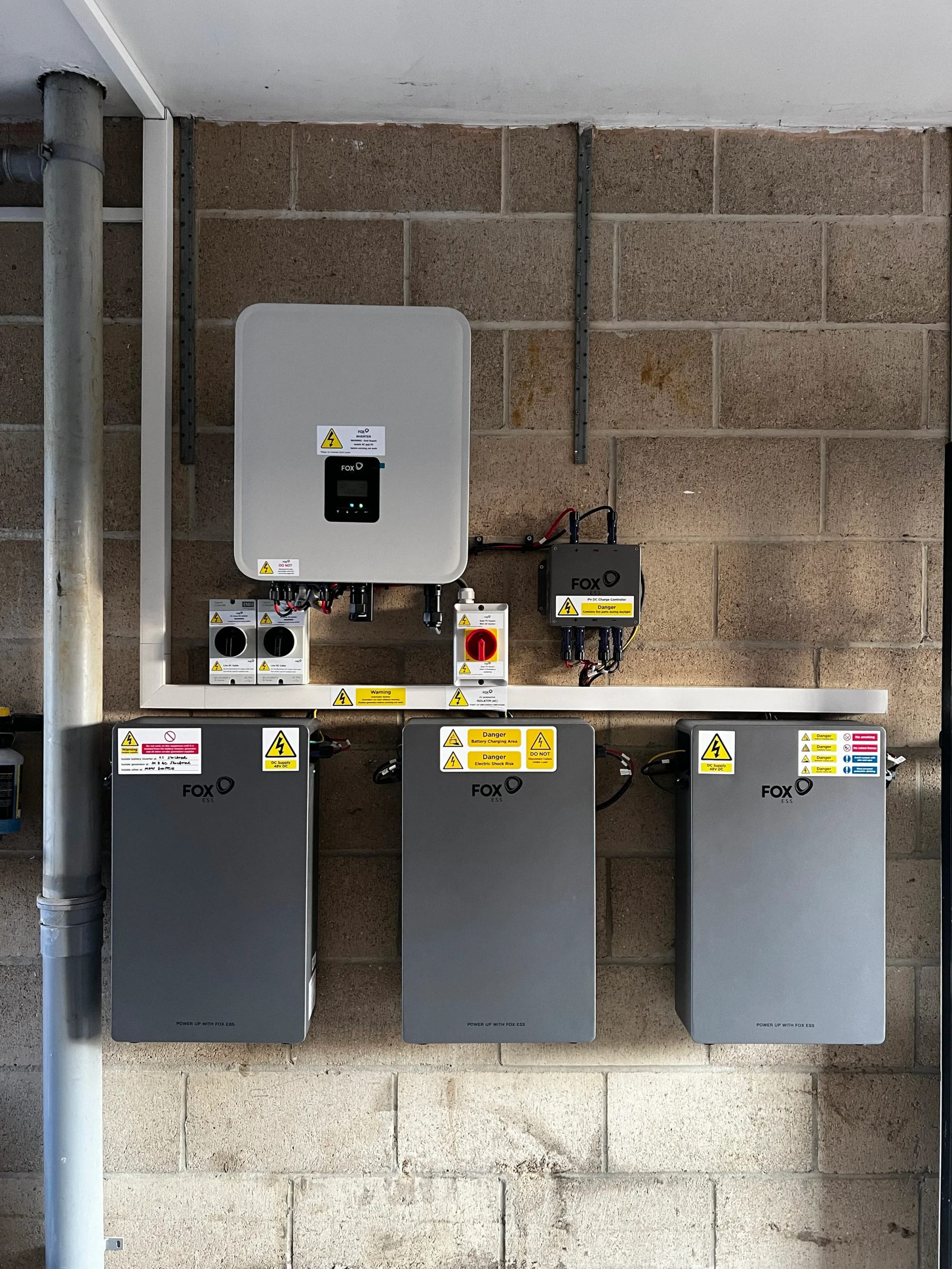
A Fox ESS battery system, as we fit it, is a stack of high-voltage EP-series batteries run by a K-series hybrid inverter, monitored and controlled through Fox’s FoxCloud 2.0 app. Fox publishes the current UK EP batteries at 5.76 kWh and 11.52 kWh per unit, up to four in parallel, and the K-series inverter in 7, 8, 9 and 10 kW. The same inverter can go in with a new solar array or join panels already on the roof, which is why it suits households that would rather add storage in steps.
The EP battery range
Fox ESS UK lists two current EP batteries:
| What Fox publishes | EP6 | EP12 |
|---|---|---|
| Energy per unit | 5.76 kWh | 11.52 kWh |
| Most in parallel | 4 units, 23.04 kWh | 4 units, 46.08 kWh |
| Depth of discharge | 90 % | 90 % |
| Enclosure | IP65 | IP65 |
| Mounting | Floor or wall, indoor or outdoor | Floor or wall, indoor or outdoor |
Depth of discharge is the share of the battery Fox designs to be used, so a 90 % figure means the battery keeps a margin back rather than running itself flat. When you compare batteries, compare the usable figure, not just the headline.
The EP6 datasheet gives a nominal voltage of 192 V, which is why Fox calls these high-voltage batteries, and a unit size of 380 × 640 × 185 mm at about 51 kg. Each battery is a manageable lift on its own, but a stack of four is a lot of weight on one wall, and the fixings and what is behind the render are part of the design.
The K-series hybrid inverter
Fox publishes the K-series as a single-phase hybrid inverter in 7, 8, 9 and 10 kW, with three or four maximum power point trackers depending on the model. It runs the panels and the EP batteries from one unit, rather than through a second box.
The datasheet adds the practical figures: IP65, natural cooling, 450 × 527 × 208 mm and 29 kg for the KH, and an operating range of −25 °C to +60 °C with derating from +45 °C. Fox lists integrated Wi-Fi and LAN on the UK page, and describes the inverter as smart tariff compatible.
There are two versions. The KH takes solar panels directly. The KA is the AC version, and the datasheet marks the PV input as being for the KH only.
New solar or a retrofit: DC and AC coupling
Fox lists the K-series as DC-coupled for new installations, AC-coupled for retrofits, and battery-ready. In plain terms:
- DC-coupled. On a new install, the panels and the batteries both connect to the one hybrid inverter. The solar power reaches the battery without being converted to AC and back.
- AC-coupled. On a house that already has panels and an inverter, the battery system joins the home’s AC wiring alongside the existing solar, which carries on as it is.
- Battery-ready. The inverter can go in first, with the batteries added later.
That flexibility is the main reason a Fox ESS battery suits a retrofit. Our guide to adding a battery to the solar you already have explains the choice between the two routes, and our battery retrofit page covers the job.
Running batteries in parallel
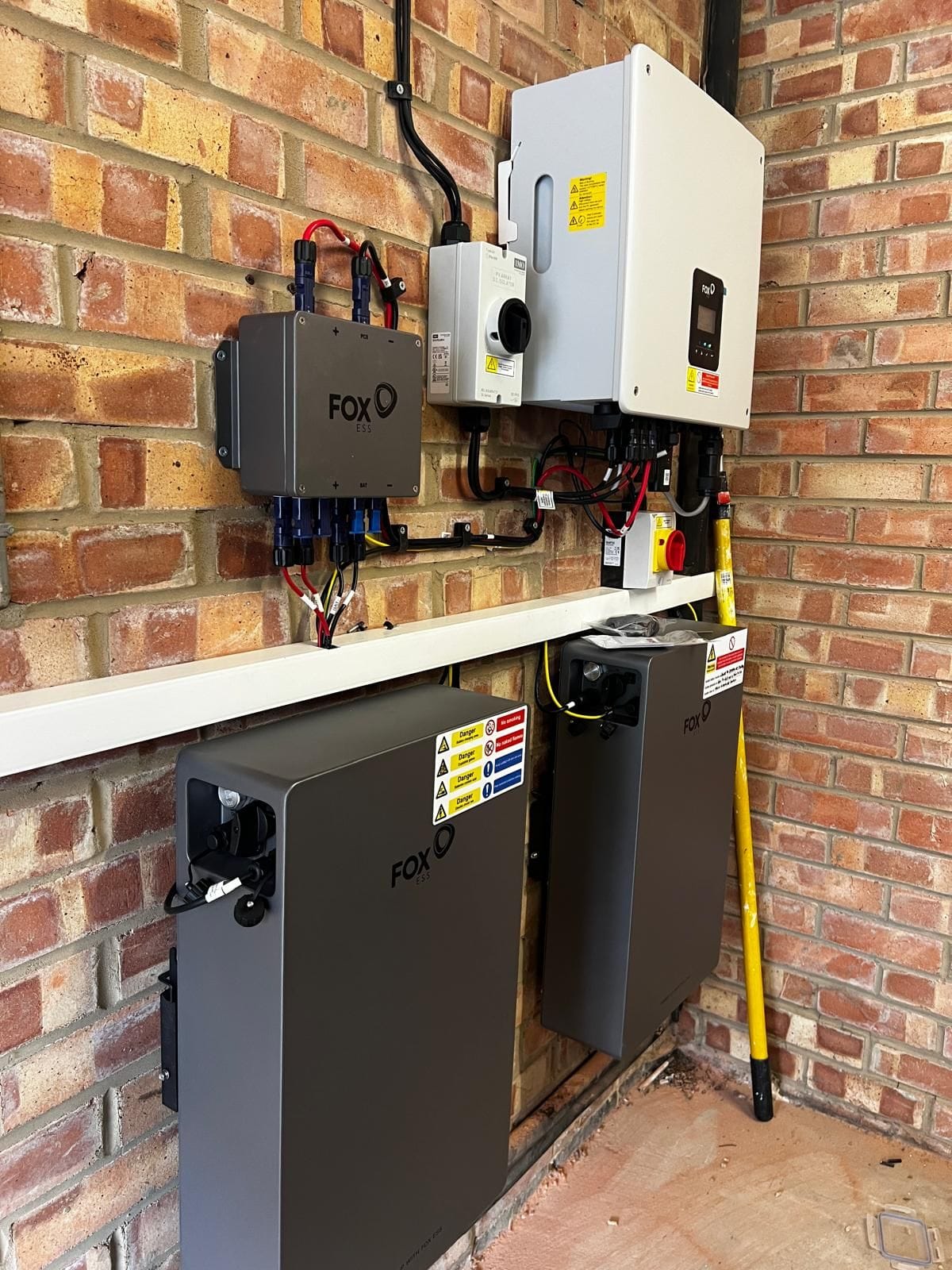
Fox allows up to four EP batteries in parallel, and requires a junction box when two to four are fitted together. The junction box takes the battery string into the inverter, and it needs its own space on the wall beside the stack. So if you think you might add a second battery later, it is worth leaving room for the junction box from the start.
Protection and the cold
Fox builds the EP batteries for an outside wall. The UK page lists IP65, natural convection cooling, internal battery warming and built-in fire suppression.
Temperature is where batteries differ most, and Fox publishes separate windows for charging and discharging:
- Charging: 0 °C to 55 °C.
- Discharging: −10 °C to 55 °C.
- With the optional warm-up function: down to −25 °C.
On a cold January morning on an exposed wall, that matters. The battery can supply the house well below freezing, but it will not take a charge below 0 °C without the warm-up function. A garage or a sheltered wall keeps it inside its comfortable range for more of the year.
FoxCloud 2.0 and the work modes
Fox monitors its systems through FoxCloud 2.0, in a web browser or synced with the Fox ESS app, with a five-second data refresh. The work modes decide what the battery does with your solar and when:
- Self-Use stores surplus solar and uses it in the house before buying from the grid.
- Feed-in Priority sends solar to the grid first.
- Back-Up holds charge in reserve for a power cut.
- Peak Shaving limits how much the house draws from the grid at once.
- Mode Scheduler sets different modes for different times, which is how a battery is told to charge in a cheap overnight window.
- AI Mode schedules charging and discharging from your habits, the weather and tariff data, and VPP Control lets the system take part in grid services.
Fox notes that some features are not in the initial release and will follow later, so what you see in the app may change over time.
Keeping the house running in a power cut
For whole-home backup, Fox sells a separate gateway, the EPS-BOX-SP, which switches the house between grid and battery automatically. Fox publishes a typical transfer time of about two to three seconds and lists the K-series among the compatible inverters. It is an extra box on the wall, so if backup matters to you, raise it at the survey.
Is a Fox ESS battery any good? What to weigh up
We are installers, not reviewers, so rather than a verdict, here is what we would weigh:
- Steps, not one big decision. EP batteries stack in parallel and the inverter can be battery-ready, so storage can grow with you.
- New or existing solar. The K-series is published for both, which keeps the options open on a retrofit.
- The cold. The charging window starts at 0 °C unless the warm-up function is used, so the wall matters.
- Space. An inverter, up to four batteries and a junction box, plus a backup gateway if you want one, all need wall room.
- The app. FoxCloud 2.0 gives you the work modes and the scheduling; check the features you care about are live rather than promised.
What we’d do
We look at your usage, the solar you have or are planning, and whether backup matters, then choose the inverter rating and how many EP batteries to start with. The inverter and batteries go on one wall run with the DC and AC isolators between them, every one labelled, and we leave room for the junction box if more batteries are likely. We send the network operator paperwork, which our G98 and G99 guide explains, and set the work modes with you in the app before we leave.
Fox ESS fitting near you
There is more on our Fox ESS page and our home battery storage page. We fit Fox ESS systems across Cheshire, Merseyside and the Wirral and Greater Manchester.