
Solar panels on a flat roof: how they're fitted and what's allowed.
How solar panels are fixed to a flat roof, why ballast needs a wind calculation and an engineer, the roof warranty, and the planning limits that apply.
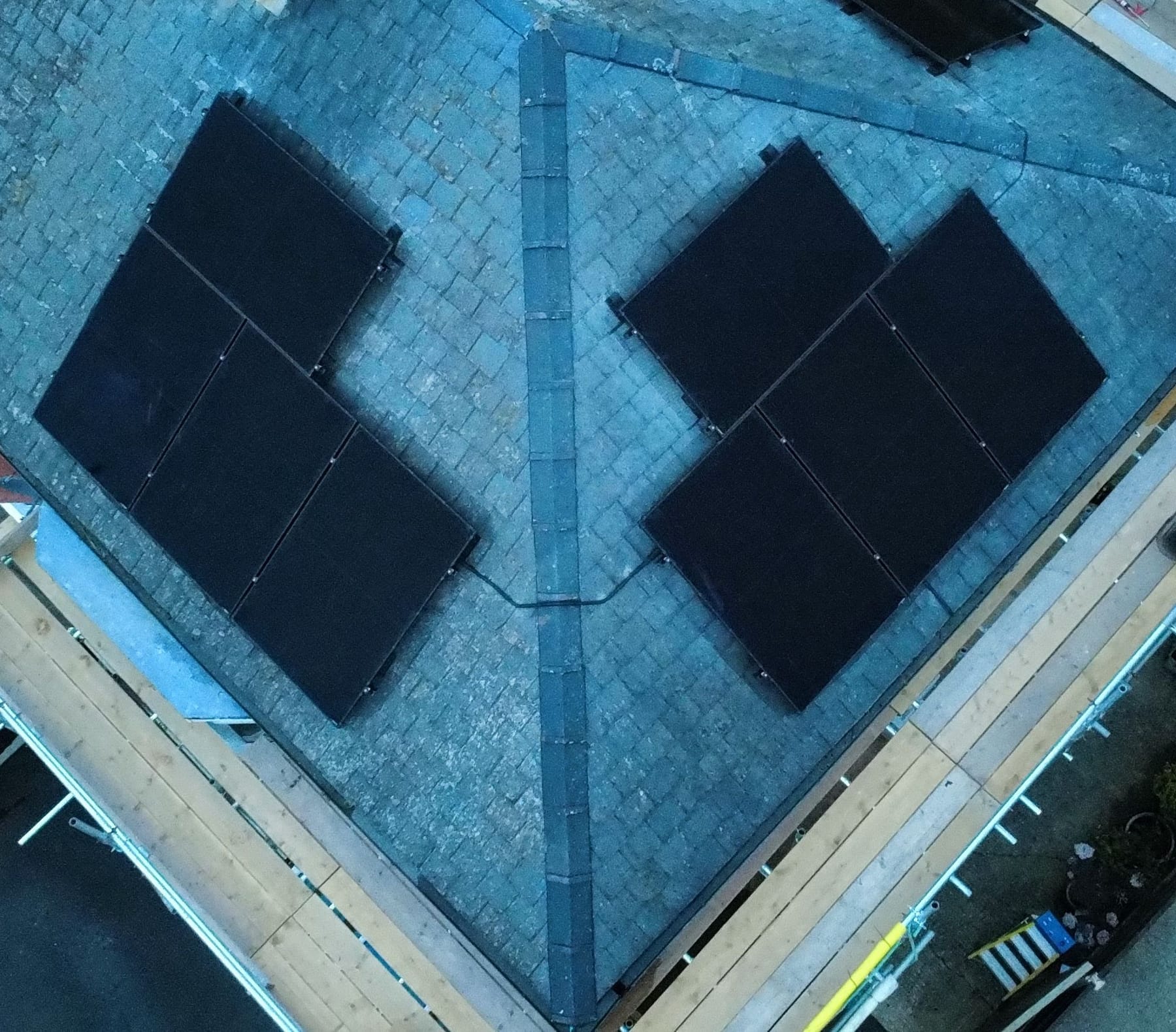
A flat roof can carry solar panels perfectly well: garages, extensions, dormers and bungalows with a flat section are all candidates. The difference from a pitched roof is how the panels are held down. On a pitched roof the frame screws into the rafters. On a flat roof it is either fixed into the deck or held down by weight, and each route comes with checks the installation standard spells out.
What counts as a flat roof
MCS, the scheme that certifies solar installers, defines a flat roof in its installation standard, MIS 3002, as one at an angle of less than 10° to the horizontal. Anything at 10° or steeper is treated as a pitched roof.
Two ways to hold the panels down
Mechanically fixed. The mounting system is fixed through to the roof deck. Where the deck is solid, such as concrete or brick, the standard says a condition survey should be carried out and pull-out tests done. Where the build-up of the roof can’t be worked out from the survey, so the holding power of a fixing can’t be calculated reliably, the pull-out tests follow the Single Ply Roofing Association’s site protocol for flat roofs.
Ballasted. The frame sits on the roof and is held down by weight, with nothing going through the waterproofing. That avoids new holes in the membrane, but the standard is strict about the sums:
- The wind pressure coefficients come from BRE Digest 489, or from test data commissioned specifically to measure wind loads on solar systems.
- A protection or slip layer goes under the frame, and it has to be confirmed as compatible with the roof’s waterproofing.
- Resistance to sliding is calculated with a coefficient of friction of 0.3, unless the actual combination of materials has been tested.
- On a gravel or green roof, the sliding calculation must use a tested value, or the system must be restrained mechanically, for example with a kerb in front of the panels or tether cables to a fixed point.
- A qualified structural engineer must be consulted to confirm the roof can take the combined weight of the panels and the ballast.
That last point is the one people don’t expect. Ballast is heavy by design, and a flat roof over an extension wasn’t necessarily built with extra load in mind.
The roof itself
The standard’s starting point is that a PV system shouldn’t affect the weathertightness or the structure of the building, for the life of the system. If the roof covering is still under warranty, the warranty provider should be asked first whether the installation would void it. A new membrane with years left on its guarantee is worth protecting.
Edges matter too. MIS 3002 says panels shouldn’t be mounted within 400mm of any edge of a domestic roof unless specific measures are taken, because wind uplift is strongest there.
Planning on a flat roof
In England, panels on a flat roof of a house are normally permitted development if the highest part of the array is no more than 0.6 metres above the highest part of the roof, chimneys aside. That height limit is what decides how tall a tilted frame can be. On protected “article 2(3) land”, which includes conservation areas, you first ask the council to decide whether it needs to approve the panels’ appearance. A listed house needs consent whatever the roof.
In Wales the rules differ. A flat-roof array may not sit within 1 metre of the roof’s outside edge or stand more than 1 metre above the plane of the roof. Our guide to whether solar panels need planning permission covers both countries in full.
What we look at on a flat roof
The survey starts with what the roof is made of and how it’s built, because that decides between fixing and ballast. Then we look at the condition and age of the membrane, any warranty on it, the distance to every edge, and what’s above the roof that might shade it. The design then has to work inside the planning height limit, and the paperwork includes the usual G98 or G99 notification to the network operator, which our G99 application guide explains.
A flat roof can also be the way to add panels to a house that already has an array on its main roof, or to make room for more generation alongside a battery. If yours is flat, or partly flat, mention it when you get in touch. Our solar PV page sets out how the survey and the design run, and we cover Cheshire and North Wales, Merseyside and the Wirral and the south of Greater Manchester.