

EV charging in Manchester: cars, public chargers and charging at home
EV charging in Manchester: 6,250 private plug-in cars, 756 public chargers, and the rules for a home charger, including the 21 October 2026 change.
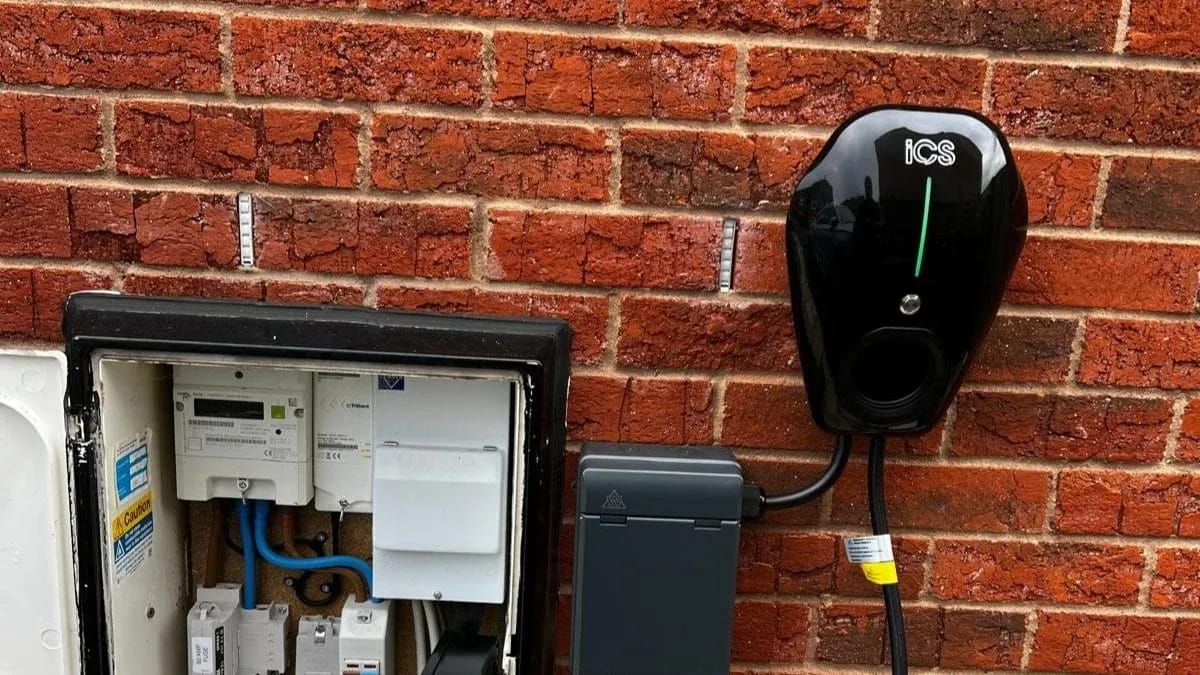
Manchester City Council covers Manchester among the towns we work in. At the end of June 2026 the DfT counted 6,250 privately kept plug-in cars licensed in Manchester, up from 4,183 a year earlier: about 49% more in twelve months. 3,566 of them are fully battery electric and the rest plug-in hybrids.
Public chargers in Manchester
On 1 July 2026 there were 756 public chargers across Manchester, 206 of them rapid chargers of 50 kW or more: about 128 for every 100,000 people. By constituency, the counts around the towns we cover were:
- Manchester Central: 441 public chargers (64 at 50 kW or more), against 415 on 1 January 2026
Public chargers are what make a long journey work. The charging that sets the running cost is the overnight kind, on your own drive, on a tariff with a cheap night window: our guide to Intelligent Octopus Go with a home charger explains how that works.
Who can charge at home in Manchester
Off-street parking is the deciding factor, and the Census does not count driveways. What it does count is the kind of home: around the centres of the towns we cover here, in 2021,
- Manchester: 39% of households in a house (3% detached, 13% semi-detached), 61% in a flat, and 48% with a car or van
A detached or semi-detached house is where a drive, and a home charger, is most likely. A flat with its own allocated space can have one too, and that is who the government grant is for.
Planning for a home charger in Manchester
In England a wall-mounted charging outlet in an area used for off-street parking is permitted development, as long as the house is not listed and the spot is not a scheduled monument; the old rule keeping it 2 metres back from a road was removed in May 2025.
From 21 October 2026 a wall charger can also go anywhere within the curtilage of a house or a block of flats as permitted development: no higher than 1.6 metres, one outlet per curtilage, sticking out no more than 0.2 metres, with 1.5 metres of footway left clear, and with an authorised cross-pavement solution for any cable over a footway. On that new route it is not permitted development in a conservation area.
Manchester City Council does not give a total of its conservation areas on the page we read. The council lists each of its conservation areas with an individual boundary map. Check an address on Manchester City Council’s conservation-area page; our solar planning guide for Manchester lists the areas it names.
The whole picture, England and Wales side by side: do you need planning permission for an EV charger?
What the charger itself has to do
Since the Electric Vehicles (Smart Charge Points) Regulations 2021, a home charger has to be smart: it comes with default charging hours set outside the weekday peaks (8 to 11 in the morning and 4 to 10 in the evening), the owner can override them, and it applies a random delay of up to ten minutes to each charge. A 22 kW charger needs a three-phase supply and most UK homes are single phase, so a home charger is normally 7 kW or so; Hypervolt publishes its Home 3 Pro at 7.4 kW single phase.
A home charger is notified to the network operator. Under the Energy Networks Association’s connect-and-notify process, where the home’s maximum demand stays at 60 amps per phase or less the charger is fitted first and notified within 28 days; above that, the operator is asked first. Electricity North West’s own page puts it plainly: notify the network operator once the charge point has been installed, and apply first if the total demand goes over 13.8 kW, or 60 amps per phase; a looped supply needs a new supply. We send the notification for you.
Grants
There is no government grant for a charger at a house you own. The EV chargepoint grant is for people who rent, or who own and live in a flat, with private off-street parking: it pays 75% of buying and installing a socket up to a cap set by the government, until 31 March 2027, and only through an installer OZEV has authorised. Who qualifies, and what the grant pays: EV charger grants in 2026.
Charging from the roof in Manchester
A south-facing roof in Manchester makes about 888 kWh a year for every kWp of panels by the PVGIS model, most of it between May and July. A solar-aware charger such as the Hypervolt Home 3 Pro can put that surplus into the car instead of exporting it: charging an EV from your own solar explains how the charger and the panels share it, and Hypervolt installation across Greater Manchester covers the charger we fit.